Quick answer: If you need a toilet right now in Korea, search for the nearest police box (지구대 or 파출소) in Naver Map. They are open 24 hours and found in almost every neighborhood. Otherwise, try the places below in order, from top to bottom.
I recently read a news article saying that foreign travelers in Korea often struggle to find a toilet when they need one urgently. My first reaction was surprise. Korea is generous with restrooms, and Koreans rarely think twice about using one.
But then I thought again. In an unfamiliar country, with signs you can’t read and no idea which buildings are open, finding a toilet in a hurry is not easy at all.
So here is how I, as a Korean, find a toilet when I’m in a hurry. The tips are based mainly on Seoul and other big cities. Smaller towns may differ.
Where to Find a Toilet in Korea: 6 Places to Try in Order
1. Subway stations
This is the one most people already know. Seoul has a huge number of subway stations, so a station toilet is usually the easiest option.
There are a few things to keep in mind. Depending on the station, the toilet may be inside the ticket gates or outside them. It may also be at the opposite end from the exit you came in, so you might have to hurry. At busy stations, there can be a line, especially for the women’s room.
My tip: when you travel by subway, use the toilet when you first enter a station or when you leave one. Look for the toilet sign and stop by while you can.
Also note that after the subway stops running for the night, toilets inside the gates can’t be used. Many station entrances are also shuttered late at night.
2. Public offices (police boxes come first)
This is where I personally go most often when I’m in a hurry. Police stations, neighborhood police boxes, and fire stations are my top choices because they are open 24 hours.
Police boxes in particular are everywhere. Every neighborhood has one, and the busier or more crowded the area, the closer the nearest one tends to be. In Korean they are called 지구대 (jigudae) or 파출소 (pachulso). Of course, rushing in may startle the officers a little, and I always feel a bit sorry about that.
District offices (구청), community service centers (주민센터), and welfare centers are almost always open during the day. At night the main door may be closed, but staff on duty usually keep a side door open. That door can be hard to find, though.
You can find all of these public offices easily on a map app.
3. Office buildings with a security desk
I mean the taller buildings that have a security guard or building manager on the ground floor. If you see a building you have to look up at, go inside.
These buildings usually have a toilet on the first floor. If it’s locked, the best thing to do is ask the guard or manager.
4. Gas stations
Gas stations and LPG stations almost always let you use their toilets, and many of them take part in Korea’s open toilet policy. Many are open 24 hours, so you can use them even in the early morning. Cleanliness, however, is hit or miss.
5. Chain stores like McDonald’s and Starbucks
These have become harder to use without buying something. These days, it’s common for the toilet code to be printed at the bottom of your receipt.
Still, they are worth a try. If the store is inside a large building, you will probably use the building’s shared toilet, which almost always needs a code. If the store has its own standalone building, the toilet is usually inside and managed by the store, often on the second floor.
Even if you don’t order, you can ask the staff if you may use the toilet. They will either ask you to order something or simply tell you the code.
6. Convenience stores
There are convenience stores everywhere, and they are open 24 hours. But they have become harder to use too. If you ask to use the toilet, be ready to hear no. Many stores are run by part-time staff, and if the owner has told them not to let outsiders use the toilet, they will usually say no. That is why convenience stores are last on this list.
Department stores, malls, underground shopping centers, and tourist information centers
I left these out of the list because they are easy to use. Department stores and malls have clean toilets on almost every floor. Underground shopping centers, like those in Myeong-dong and Gangnam, and tourist information centers are also good options on typical travel routes.
Tricky Situations
When you’re at a traditional market
Personally, I try not to use the toilets in traditional markets. They have improved a lot, but cleanliness is often lower. Still, when I’m in a hurry, I look for them too. The problem is that market toilets are really hard to find.
Mangwon Market and Gwangjang Market show the typical layout of a Korean traditional market. Rows of two- or three-story buildings are joined together, with shops on the ground floor. Large markets sometimes have toilets on the ground floor, but they are more likely to be on the second or third floor.
There are toilet signs here and there, but the shop signs on the ground floor make them hard to spot. If you can’t find a sign quickly, look around for stairs going up. Going up to the second floor and walking around is often the fastest way.
When you’re in a taxi
The best thing to do is ask the driver to take you to the nearest gas station. Just say you need a toilet, and the driver will understand. Gas stations have space to park for a moment, so drivers rarely mind. The meter will keep running while you’re inside, but that’s not a big deal.
It’s harder when the taxi is on an expressway or a road with no traffic lights. In that case, just tell the driver you need a toilet instead of asking for a gas station. It will be faster.
When you’re deep in a back alley
These days, small alleys far from the main roads have become popular travel spots. If you suddenly need a toilet there, first search for a police box (지구대 or 파출소) in your map app. If one is close, go there.
If not, you’ll have to use a toilet in one of the buildings nearby. These buildings are usually three to five stories tall. The first and second floors have restaurants or hair salons, and the upper floors are homes. There is usually one entrance, and the commercial floors each have a toilet.
In the past, the first-floor toilet might be locked, but the second-floor one was often open. Now most are locked or have a keypad. The fastest way is to walk into a first-floor shop and politely ask if you can use their toilet.
Final Tips
Carry a pack of pocket tissues
It’s a good idea to buy a small pack of pocket tissues, just in case. Korea actually has quite a lot of public and open toilets, especially in Seoul, but toilet paper can run out.
Toilet or bin? It depends on the place and the paper
In Korea, some toilets ask you to flush paper and others ask you to use the bin. Public toilets in subway stations and parks usually ask you to flush it. Many shop buildings and older buildings still ask you to put it in the bin. If there is a bin in the stall or a sign, follow it.
There is one more thing to watch out for. Only toilet roll paper, which breaks down easily in water, should be flushed. Pocket tissues don’t break down well and can block the toilet. If you use pocket tissues, put them in the bin, not the toilet.
Emergency bells
Many public toilets in Korea now have an emergency bell inside the stall. If you use a toilet late at night and feel unsafe, it’s good to know it’s there.
Don’t be afraid to ask
If you can’t see any toilet nearby and have to ask a shop or convenience store, don’t hesitate. Asking is the fastest way. Most people will understand “toilet” or “restroom” in English. But a few words of Korean will go a long way:
- 화장실 어디예요? (Hwajangsil eodiyeyo?) — Where is the toilet?
- 죄송합니다만, 화장실 좀 이용해도 될까요? (Joesonghamnida-man, hwajangsil jom iyonghaedo doelkkayo?) — Excuse me, may I use your toilet?
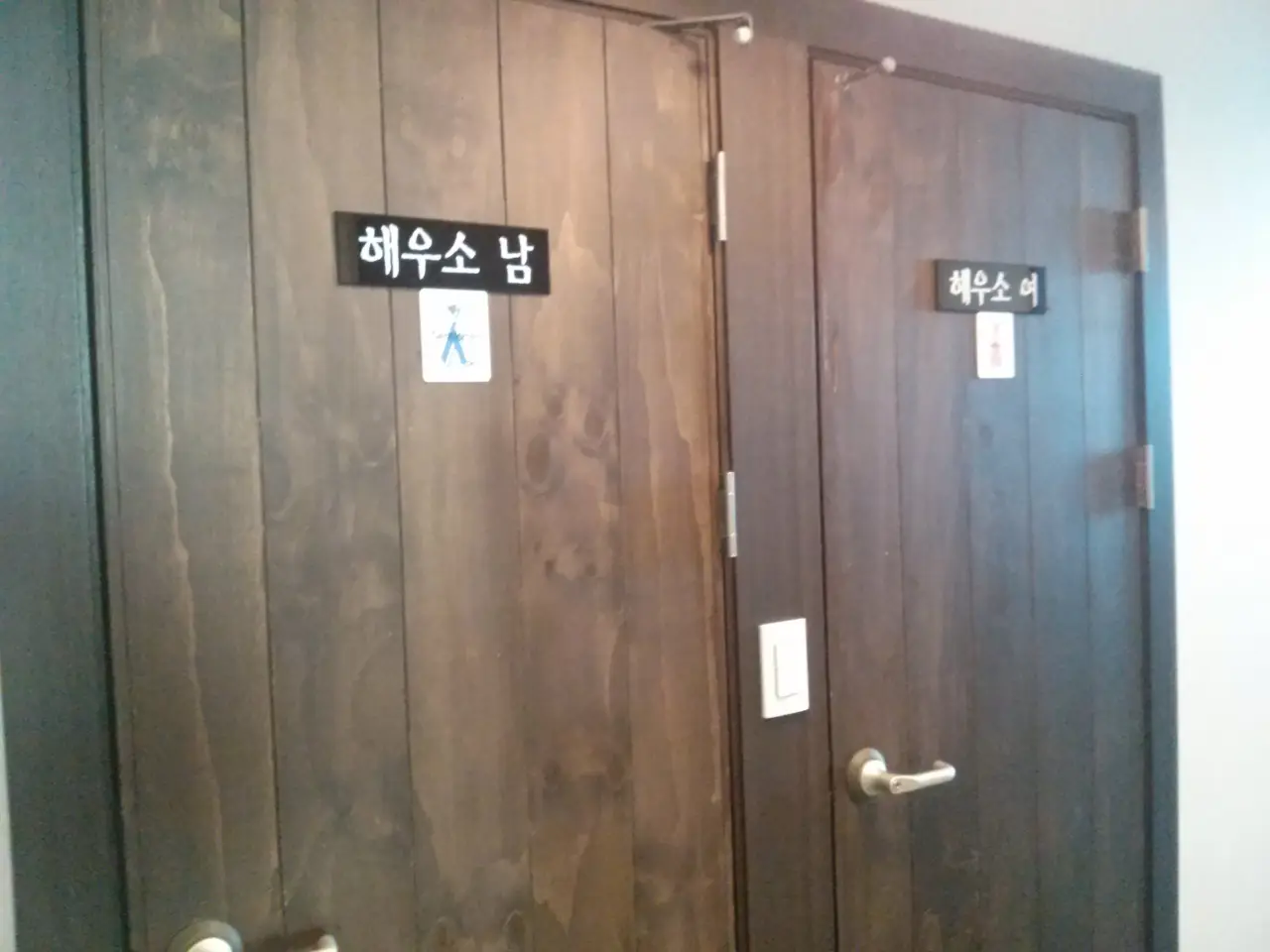
Most toilets are labeled 화장실 (hwajangsil). But you may also see the word 해우소 (haewooso), like in the photo above. It originally comes from Buddhist temples and means “a place to relieve your worries.” Both mean restroom. Men’s rooms are marked 남 (nam) and women’s rooms 여 (yeo).
In Korea, Naver Map and Kakao Map work much better than Google Maps. Koreans rarely use Google Maps, so its local data is thin, and walking and driving directions are limited. I recommend installing Naver Map before your trip. It supports English and Japanese, and you can search for 화장실 or 공중화장실 (public toilet) to see toilets near you. Search 지구대 or 파출소 to find police boxes.
Koreans also check toilet information before visiting a new place. Naver blogs are full of posts like “Gwangjang Market toilet” or “Mangwon Market toilet review.” It’s a pity that most foreign visitors can’t read them.
Remember this one tip
If you remember only one thing from this post, make it this: when you need a toilet urgently, search for the nearest police box (지구대 / 파출소) and go there. I’ll add more tips here as they come to mind.
If you found this helpful, feel free to share it. If you quote or use any part of it, please credit Look at Korea with a link to this post.