Losing your bag in Korea is stressful. Losing the medicine inside it can be a real problem.
If you only lost painkillers or cold medicine, relax. Korean pharmacies (약국, yakguk) sell most common over-the-counter medicines without a prescription, and convenience stores carry a few basics too.
The hard part is prescription medication you take every day — blood pressure pills, diabetes medicine, cholesterol drugs, thyroid hormone, blood thinners, insulin. Skipping these for even a few days can be risky, and you can’t just buy them at the counter.
This guide walks you through exactly what to do.
The one rule you need to know first
Korean pharmacies do not accept foreign prescriptions. Prescription-only medicines are dispensed only with a prescription written by a doctor licensed in Korea. Showing your pill bottle or your home-country prescription at the pharmacy will not work.
Also, Korea has no “refill” system that lets you reuse a prescription. Each prescription is used once at the pharmacy.
So the path is always the same:
Find your drug info → See a Korean doctor → Take the new prescription to a pharmacy.
The good news: for common chronic conditions, this is usually quick and fairly cheap.
Step 1. Recover your medication details (before the clinic)
The doctor needs three things for each medicine:
- Generic name (active ingredient) — e.g. amlodipine, metformin, atorvastatin. Brand names differ by country, so the generic name matters most.
- Strength — e.g. 5 mg, 500 mg, 20 mg.
- How you take it — e.g. once a day in the morning.
Lost the bottle too? Try these:
- Pharmacy, insurance or health apps. Your regular pharmacy app, insurer app or national health app often keeps a record of recent prescriptions — for example, Japan’s electronic medicine notebook (お薬手帳) apps or the UK’s NHS App.
- Your hospital patient portal. Your clinic’s or hospital’s portal or app usually shows your current medication list and visit records.
- Your email and phone photos. Search for “prescription”, “pharmacy”, or your drug name. Many people have a photo of their pill bottle without realizing it.
- Contact home. Message your doctor’s office or regular pharmacy and ask for a medication list (generic name + dose). Mind the time difference — send it as soon as you notice the loss.
Screenshot everything and keep it on your phone. If you can get a short English letter or medication list from your doctor, even better.
Step 2. Go to a local clinic, not a university hospital
For chronic conditions, visit a neighborhood clinic (의원, uiwon):
- Internal medicine — 내과 (naegwa)
- Family medicine — 가정의학과 (gajeong-uihakgwa)
These are everywhere, usually walk-in, and often see you within an hour.
University hospitals require a doctor’s referral letter to register and be seen on the same day. Even then, walk-in patients are seen only after all booked patients, so you can wait a very long time.
Some mid-sized hospitals that aren’t university hospitals have a foreign patient desk or interpretation service. They can help if you need more language support, but they cost more than a local clinic.
Tip: Search “내과” on Naver Map or Kakao Map to find clinics nearby with opening hours.
Tip: Don’t worry if you don’t speak Korean. Phone translation apps can now interpret conversations in real time. Turn on conversation mode in Papago or Google Translate and talk with the doctor, front desk staff and pharmacist.
Step 3. At the clinic
- Bring your passport. Foreign visitors register with a passport.
- Explain the situation. Show the medication info on your phone and say you lost it while traveling.
- Ask for 2–3 extra days. Tell the doctor how many days you’re staying, and ask for a few extra days’ supply in case your flight is delayed.
- Pay. As a tourist you’re not covered by Korean national health insurance, so you pay the full price. For a simple visit at a local clinic, the cost is usually still modest.
The doctor will write a prescription for the same ingredient — or a similar drug in the same class if the exact one isn’t sold in Korea. Ask if the dose looks different from what you’re used to.
Note: Local clinics can prescribe up to 3 months (90 days) at a time, but doctors usually won’t prescribe that much — especially when they’re matching an existing prescription rather than treating you over time. If you really need it, you can ask. Keep in mind that bringing a large supply of medicine home may cause problems at customs in some countries.
Step 4. Pick up your medicine at the pharmacy
In Korea, clinics and pharmacies are usually close together — right next door, in the same building, or on the ground floor. The easiest way to find the nearest one is to ask when you pay at the clinic.
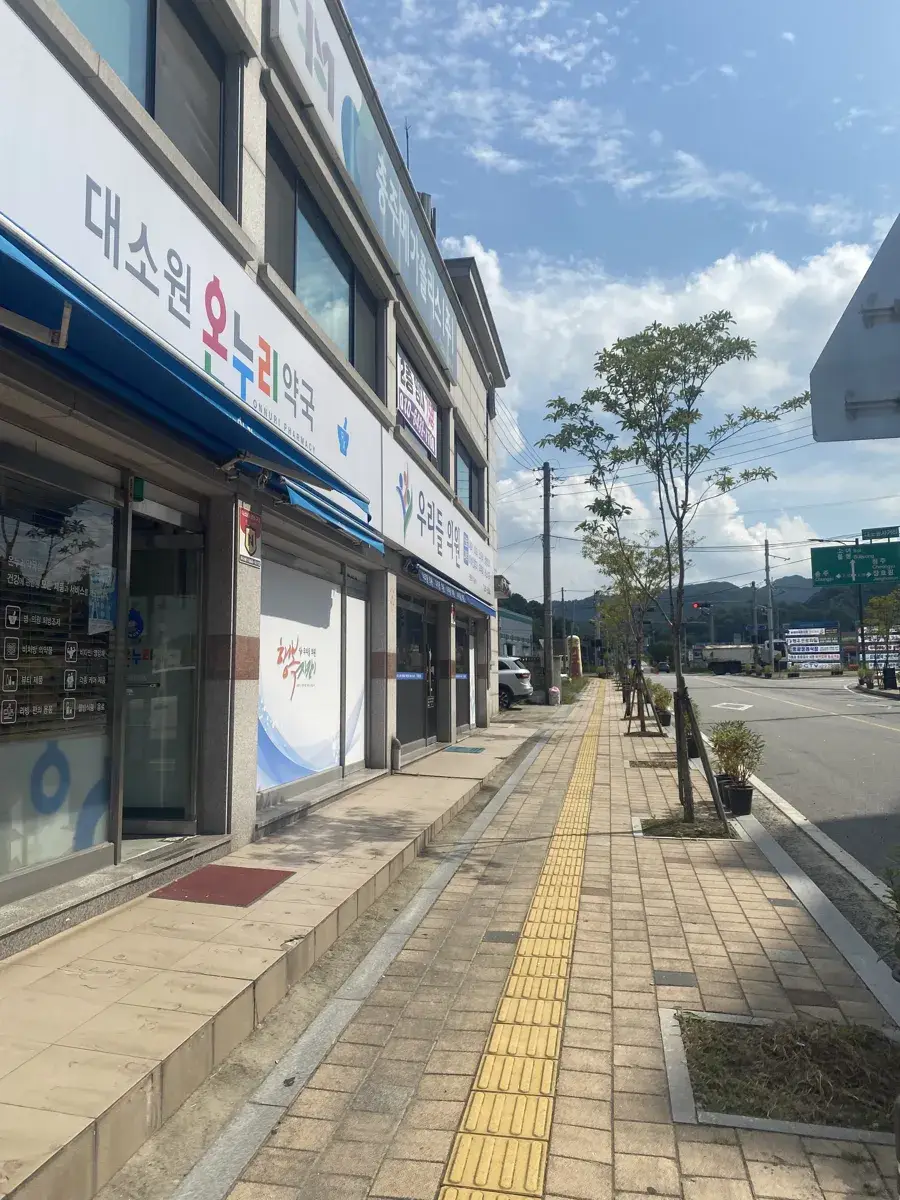
Hand over the prescription and the pharmacist will prepare your medicine. Use your translation app to confirm the drug name and dose with the pharmacist.
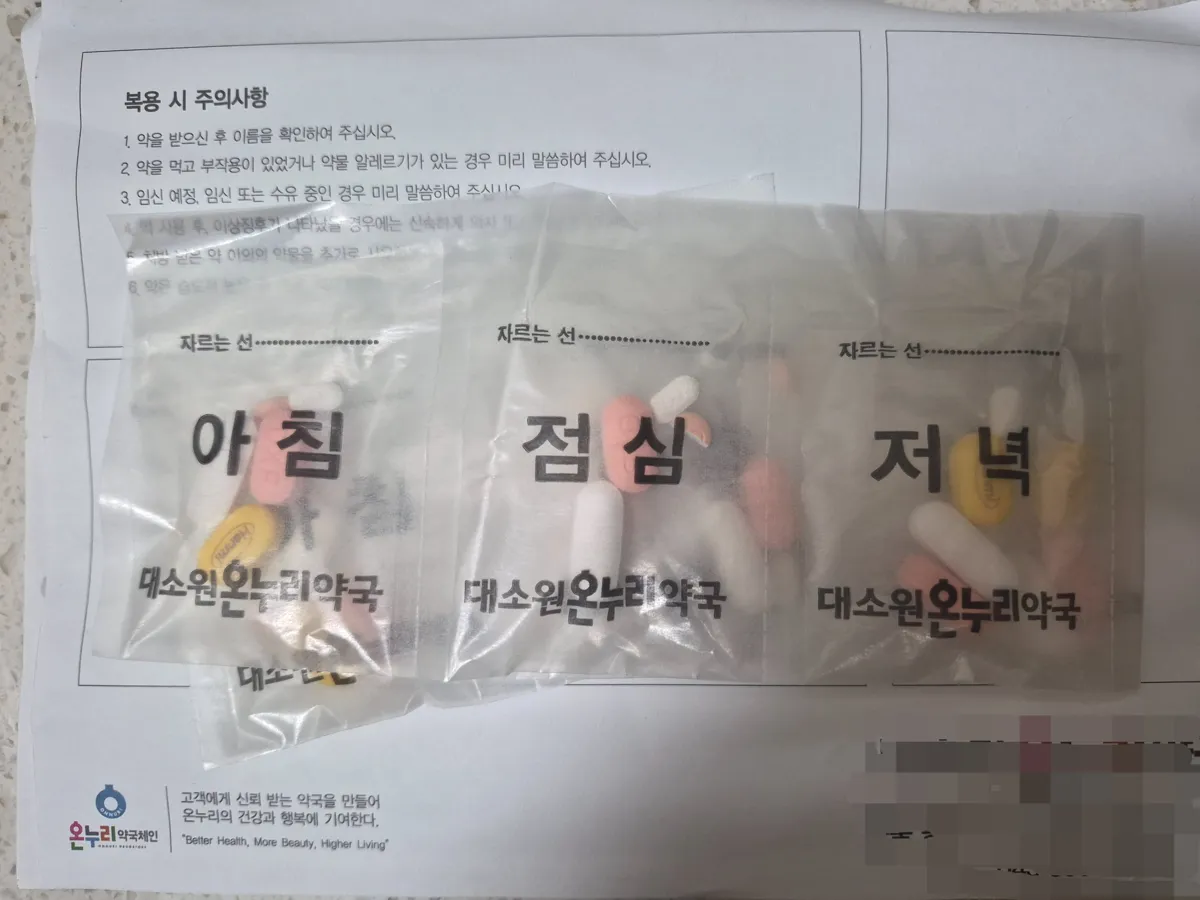
Korean pharmacies often pack each dose in its own small packet. The pharmacist will explain how to take it, and may mark the packets with the time of day — morning, lunch, evening.
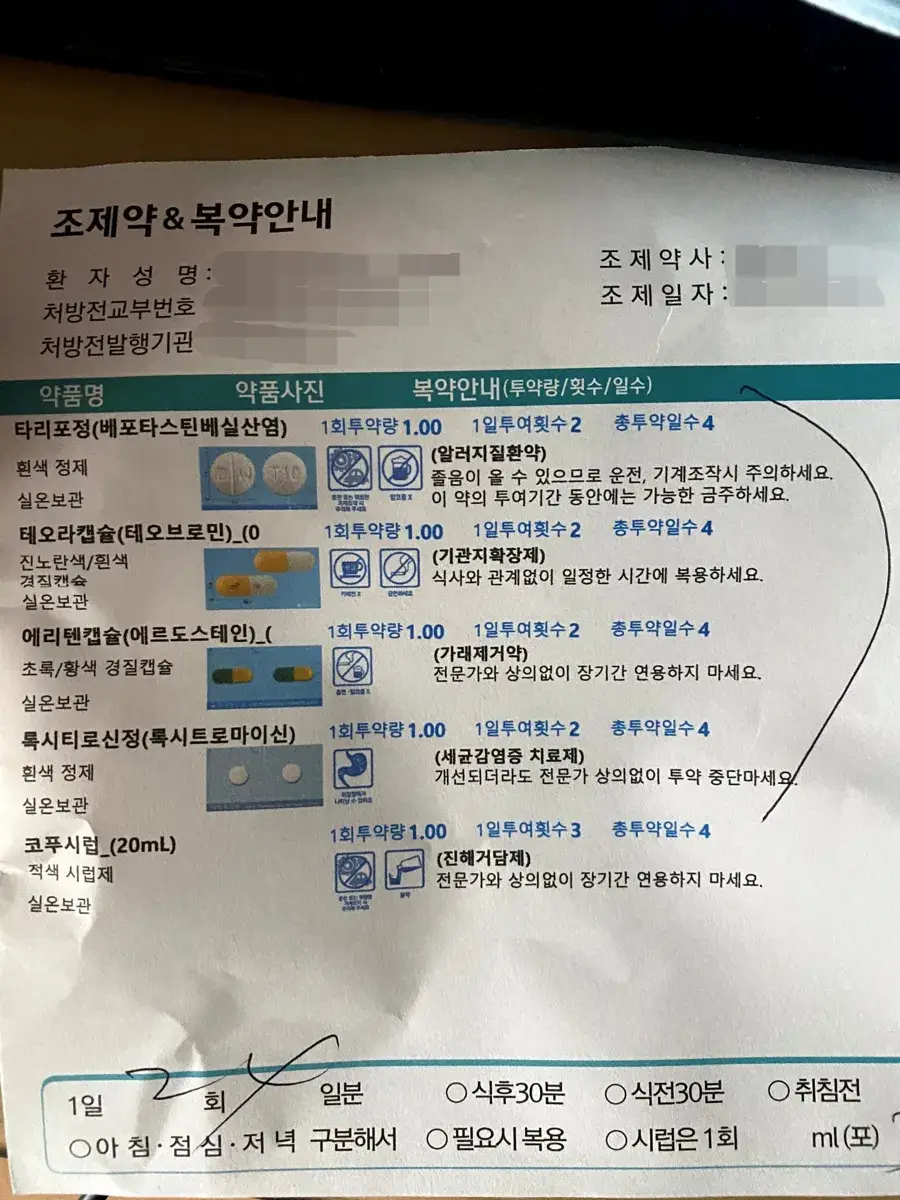
You’ll also get a medication information sheet (복약 안내문). It lists each drug’s name with the active ingredient in brackets, a photo of the pill, the dose, how many times a day, the number of days, and warnings. It’s in Korean, but you can read it instantly by pointing your translation app’s camera at it. Keep it and take a photo — it has all your medication details, so you can show it to a doctor next time or back home.
Special cases
Controlled medicines (sleeping pills, ADHD meds, strong painkillers)
Some medicines are classified as narcotics or psychotropics in Korea. Korea’s drug laws are strict, and even bringing these into the country can require advance approval. If you lose them, a local clinic may refuse to prescribe them or ask for more documentation.
In particular, opioid painkillers and oral painkillers with similar ingredients — which may be easy to get in your home country — are unlikely to be prescribed at a local clinic. These can be prescribed at a university hospital, and you pick them up separately at the pharmacy inside the hospital, not at a regular pharmacy. Since university hospitals take a long time, contact your home doctor quickly and get a referral letter and your medication details ready.
Insulin and injectables
Treat this as urgent. Go to a clinic the same day, or to a hospital emergency room if clinics are closed. Bring any record of your insulin type and units.
Nights, weekends and holidays
- Most local clinics close on weekday evenings, open only until about 1–2 p.m. on Saturdays, and close on Sundays and public holidays.
- Ask your hotel or guesthouse for help. Staff can tell you about nearby clinics and pharmacies or call to check for you.
- If nothing is open and you can’t wait, a hospital emergency room can prescribe and dispense urgent medication. It costs more.
- For a real emergency (chest pain, trouble breathing, very high or low blood sugar), call 119.
Phone numbers to save
- 1330 – Korea Travel Hotline (Korea Tourism Organization). Free help in English, Japanese, Chinese and several other languages. They can help you find a clinic and do three-way interpretation calls. You can also chat through the 1330 app. Hours differ by language and service, so check the app if you’re calling late at night.
- 1339 – KDCA call center. 24-hour health consultation. For foreign languages, it connects with 1330 (or the 1345 immigration center) for three-way interpretation.
- 119 – Ambulance / fire. Emergencies. 119 can also guide you to open hospitals and pharmacies.
Don’t forget travel insurance
If your bag was lost or stolen, ask the clinic and pharmacy for:
- Receipt (영수증, yeongsujeung)
- Itemized bill (진료비 세부내역서, jinryobi sebu naeyeokseo)
- Medical certificate or a copy of the prescription (진단서 / 처방전 사본)
If it was stolen, also get a police report — many insurers ask for it for theft claims. Check your policy for what it covers before you file.
This post is general travel information, not medical advice. Always follow the guidance of the doctor and pharmacist who treat you.
If you found this helpful, feel free to share it. If you quote or use any part of it, please credit Look at Korea with a link to this post.