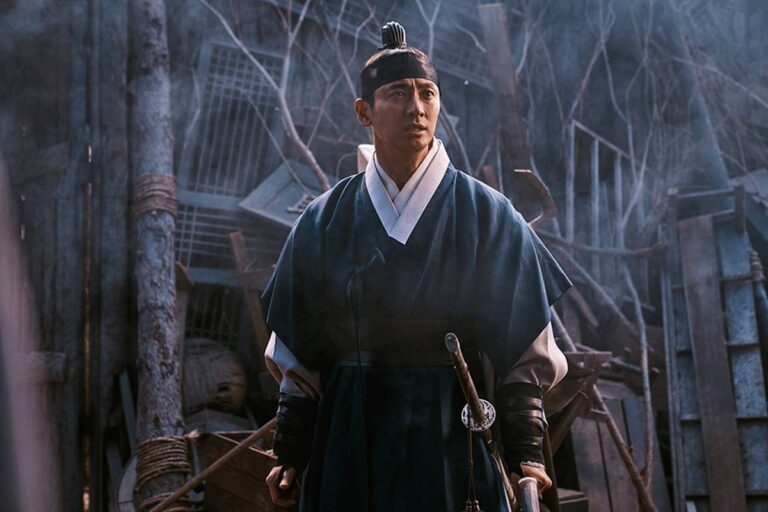
Netflix’s new period fantasy-horror series The East Palace (동궁, Donggung) premiered on July 17, 2026, and it didn’t take long for one supporting character to steal the spotlight from its A-list cast. Led by Nam Joo-hyuk, Roh Yoon-seo, and Cho Seung-woo, this occult sageuk has viewers hooked on its royal curse and ghost-hunting mystery — but the internet has fallen for something much smaller: a creature called Kkeomeoksali (also romanized as Kkeomeoksari or Ggeomeoksali).
Korean media has already nicknamed it “Joseon’s Groot.” If you’ve watched the show — or seen it all over your feed — and want to know exactly what Kkeomeoksali is and where it comes from, here’s everything you need to know.

Who Is Kkeomeoksali in The East Palace?
Kkeomeoksali is a small gwi-mae — a spirit-creature from the Realm of Gwi — who attaches itself to protagonist Gu-cheon (Nam Joo-hyuk) early in the series. With its jet-black body, round stone-like face, and enormous doll-like eyes, Kkeomeoksali looks harmless — even cute. But looks are deceiving: this creature actually feeds on yanggi, the life energy of the living.
Despite its unsettling diet, Kkeomeoksali becomes something closer to a companion than a threat. It saves Gu-cheon at several critical moments throughout the series, earning it the affectionate Korean nickname “banryeo gwi-mae” (반려 귀매), roughly translating to “companion spirit” or “pet ghost.”
Where Does the Name “Kkeomeoksali” Come From?
According to the show’s writers, Kwon So-ra and Seo Jae-won, the name is believed to combine two Korean words: “kkeomeok” (꺼먹), meaning “pitch-black” or “jet-black darkness,” and “sali” (살이), meaning “a living being” or “one who lives.” Put together, the name essentially means “the black-dwelling thing” or “the one who lives in darkness.”
The writers have said the character draws on a Korean oral urban legend: a dark, childlike figure said to emerge from the mountains, following travelers while repeating “I am Kkeomeoksali, Kkeomeoksali, Kkeomeoksali.”
It’s a Real Korean Urban Legend — Not Just a Screenwriter’s Invention
Here’s the part that makes Kkeomeoksali more than just a clever piece of creature design: it’s documented in actual Korean folklore archives.
Dosi Jeonseung Seolhwa Jaryo Jipseong 7 — Chungcheong Region (도시전승설화자료집성 7 – 충청지역), a folklore compilation edited by Professor Shin Dong-heun of Konkuk University and published by Minsokwon in 2009, contains a field-recorded oral account titled “Kkeomeoksali gwisin” (꺼먹살이 귀신, “the Kkeomeoksali ghost”). The story was collected from elderly residents during fieldwork conducted around Namseon Park in Daejeon in 2007, alongside other local ghost stories and folk tales.
In other words, the character wasn’t invented from scratch for the show — it’s a real piece of Korean oral tradition from the Chungcheong region, one that folklorists had already recorded and archived nearly two decades before The East Palace brought it to a global audience.
(Source: Dosi Jeonseung Seolhwa Jaryo Jipseong 7, Minsokwon, 2009)
Cute on the Outside, Unsettling on the Inside
Part of what makes Kkeomeoksali so compelling is exactly this contradiction: an adorable, plush-toy appearance paired with a genuinely dark nature. In one notable scene, Gu-cheon offers the injured creature a portion of his own yanggi, saying, “Here, take a little of my energy” — a small act of kindness that cements the bond between them.
That tension between “creature you want to hug” and “creature that technically drains your life force” is exactly what’s made Kkeomeoksali resonate with international audiences, some of whom have compared it to Labubu or Groot — pop culture’s other beloved “monsters you can’t help but love.”
Kkeomeoksali’s Global Moment
The East Palace is still in its first week of release, and Kkeomeoksali hasn’t fully found its official English name yet — you’ll see it spelled Kkeomeoksali, Kkeomeoksari, and Ggeomeoksali across different platforms. That naming gap is part of why now is such an interesting time to be talking about this character: the international fandom around it is still forming in real time.
Whether it ends up with its own line of merchandise or simply lives on as a beloved meme, Kkeomeoksali has already done what few background creatures manage — become the reason people keep watching.
SUGGESTED INTERNAL/EXTERNAL LINKS
- Netflix official press release: https://about.netflix.com/en/news/the-east-palace-premieres-july-17
- Netflix Tudum cast page: https://www.netflix.com/tudum/articles/the-east-palace-cast-characters
- Folklore source book: https://www.yes24.com/product/goods/3537136