Gimbap is a simple Korean food that can be eaten in a short time.
Usually, Koreans prepare Gimbap when they go on a picnic.
Gimbap is also spelled Kimbap, and both words mean the same food.
It’s just a difference in spelling: Gimbap follows the official romanization, while Kimbap is the older and more widely used spelling.
The meaning of Gimbap.
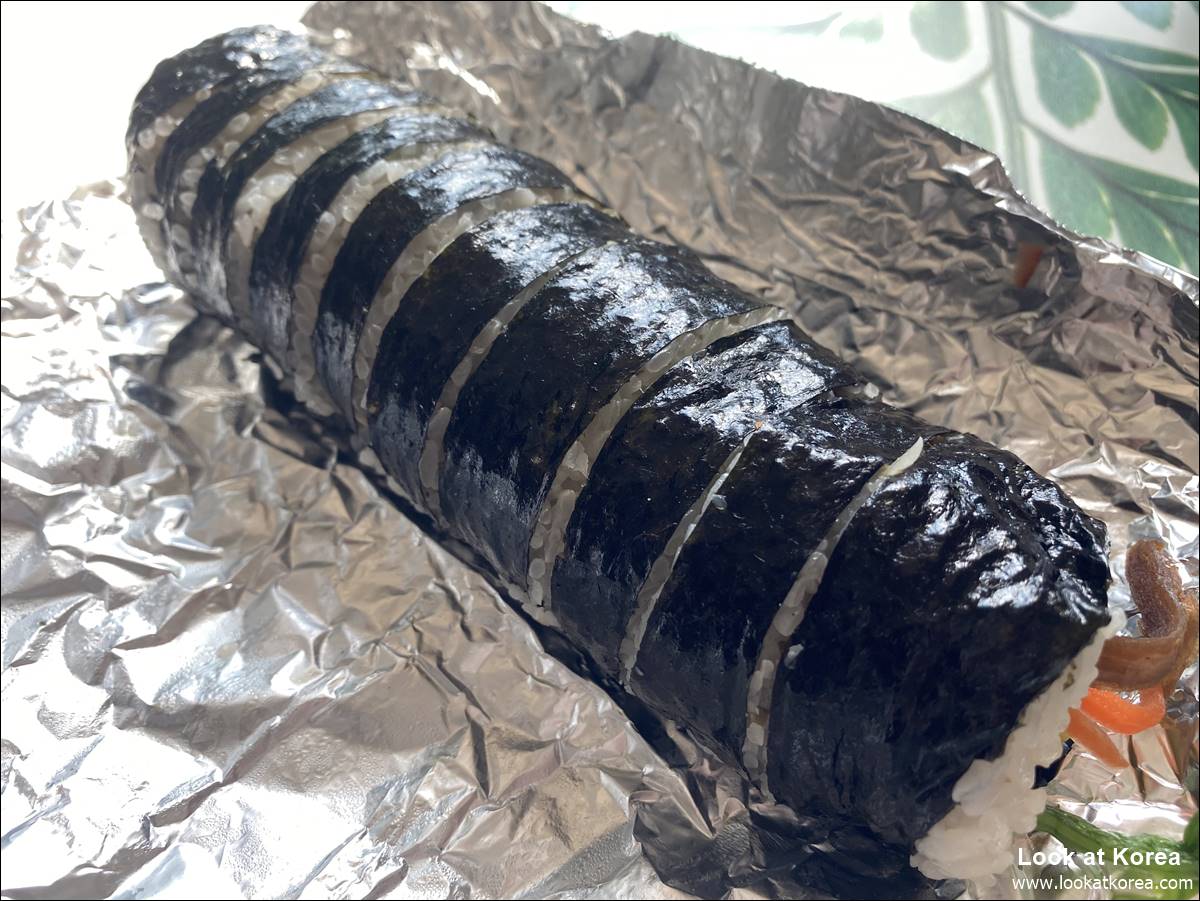
Gimbap refers to all dishes made by wrapping rice with seaweed.
Even if you wrap rice with dried seaweed, it’s Gimbap.
Even if you put rice and kimchi in seaweed and wrap it, it’s Gimbap.
Even if you wrap it with rice and other ingredients in seaweed, it’s Gimbap.
In other words, seaweed and rice are the basic ingredients, and the additional ingredients are up to the chef.
The origin of Gimbap.
Records of eating rice wrapped in seaweed were found in an old book in 1819.
In other words, it can be said that Koreans have eaten Gimbap for a long time.
The important point is that Gimbap in its present form is believed to have been influenced by Japanese sushi rolls.
In particular, given that Danmuji (pickled radish) is always in Gimbap these days, the influence of Japan cannot be ignored.
The biggest difference between Japanese rolls and Gimbap is that all the ingredients of Gimbap are cooked separately before being wrapped in seaweed.
In other words, Gimbap should be seen as a dish made by putting side dishes (banchan) on rice and wrapping them in seaweed, so that it can be eaten easily and quickly.
In the 1970s and 1980s, Gimbap became a popular food as the seaweed farming industry grew and seaweed became easy to get.
And currently, Gimbap is becoming a type of snack rather than a meal.
How Gimbap Has Changed: My Memories
When I was a child, Gimbap was the food my mother packed for me on school picnic days.
And it wasn’t just me. Almost every student came to the picnic with a lunchbox of Gimbap.
Back then, besides seaweed and rice, the main fillings were egg, carrot, burdock, fish cake (eomuk), and spinach.
Later, sausage was added. It wasn’t the sausage we know today, but a pink sausage made with very little meat and a lot of flour.
Over time, that pink sausage was replaced by ham, and later still, fish cake was replaced by crab sticks.
So today, the standard fillings are ham, egg, carrot, burdock, crab sticks, and spinach, along with danmuji.
If you order a basic Gimbap, you can expect to find these inside.
Recently, though, spinach has become a problem. It spoils quickly and has been linked to food poisoning, so many Gimbap shops started using chives instead.
Chives are tender and pleasant when they’re in season, but out of season they can be tough and chewy.
Now the trend seems to be leaving out green vegetables altogether. Some shops use cucumber instead, but it’s still not easy to find.
Personally, I find it a real pity that spinach is disappearing, because it makes a big difference to the taste.
That’s why I always add spinach when I make Gimbap at home.

The composition of Gimbap (Kimbap).
Unseasoned roasted seaweed and rice seasoned with sesame oil are basic.
It usually contains ham, eggs, pickled radish, carrots, burdock, crab sticks, and spinach.
As mentioned above, though, many shops now replace the spinach with chives or cucumber, or leave out the greens altogether.
The basic composition colors of Gimbap are black (seaweed), red (carrot), green (spinach), and yellow (danmuji).
These colors are not just for looks. Each ingredient adds something different, so a single roll covers several food groups at once.
Rice provides carbohydrates for energy, while eggs, ham, and crab sticks add protein. Carrots and spinach bring vitamins and fiber, and the seaweed itself contains minerals such as iodine. Sesame oil adds healthy fats along with its nutty flavor.
In other words, basic Gimbap is a well-rounded meal you can hold in one hand, which is also why I miss the spinach when shops leave it out.
The above composition is the most basic Gimbap.
It is also called vegetable Gimbap or just Gimbap.
It costs about 3,500 won at the cheapest places and up to 5,000 won at the most expensive ones.
Gimbap was originally a dish made by wrapping whatever was in the fridge in seaweed.
As Korea’s economy grew, the food in Korean fridges became richer and more varied, and Gimbap changed along with it.
That’s why today you can find so many kinds of Gimbap, such as tuna, cheese, beef, and bulgogi Gimbap.
In this basic Gimbap,
If there’s pork cutlet in it, it’s pork cutlet Gimbap.
If there’s bulgogi, it’s bulgogi Gimbap.
If there’s beef in it, it’s beef Gimbap.
If there’s canned tuna in it, it’s tuna Gimbap.
There are so many kinds of Gimbap.

Things to be careful about with Gimbap.
The ingredients of Gimbap are stir-fried and prepared.
Gimbap is not a food that can be stored for a long time.
Ingredients for Gimbap prepared early in the morning at restaurants that sell Gimbap may go bad during the day. Because of this, some people get food poisoning from Gimbap in the middle of summer.
In the hottest summer in Korea, it’s best to avoid Gimbap that has been sitting out for a long time.
Why I Rarely Eat Convenience Store Kimbap
Even though there are three convenience stores within a five-minute walk of my home, I eat convenience store Gimbap maybe once a year.
It’s not that it tastes bad. To me, it feels like it focuses on bold flavor rather than a balance of ingredients.
To be fair, it’s the cheapest and fastest way to fill your stomach. And because competition among Korean convenience stores is so fierce, new Gimbap and samgak gimbap (triangle kimbap) come out every month, and they keep getting better.
Still, compared with regular Gimbap, which is built around a balanced mix of ingredients, many convenience store Gimbap and triangle kimbap products feel to me like they lean on stronger seasoning or simply add more meat or cheese.
That’s why I don’t recommend them. If you can, try Gimbap that has just been rolled at a Gimbap shop.
Final thoughts on Gimbap
Gimbap is light on the stomach and tastes good.
In particular, the combination of Korean seaweed and sesame oil guarantees a sufficient taste.
If you visit Korea, I recommend trying Gimbap (Kimbap).
As mentioned above, if you purchase Gimbap, you should eat it as soon as possible.
And if possible, buy it freshly rolled rather than pre-packaged.
If you found this helpful, feel free to share it. If you quote or use any part of it, please credit Look at Korea with a link to this post.